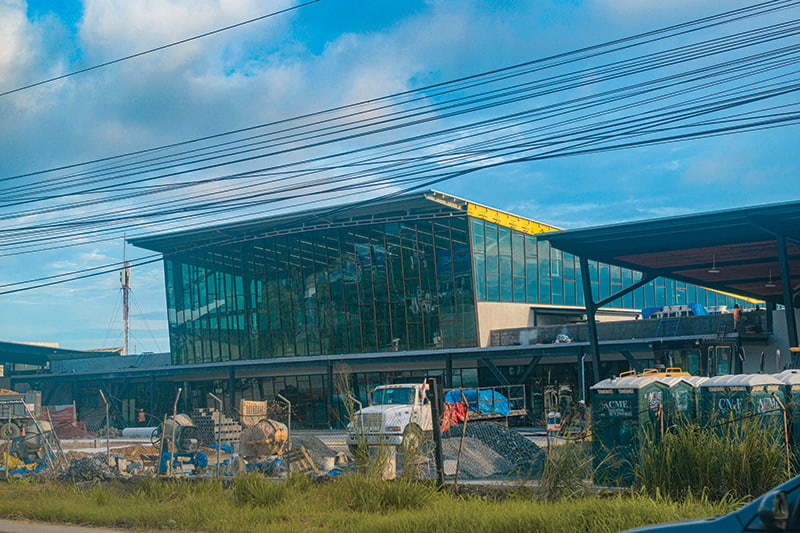
Roatan is Becoming an Important Transportation Hub
Roatan’s airport upgrade is just in time, as by 2030 Roatan’s airport passenger traffic is expected to expand to 260,000 domestic passengers and to 730,000 passengers flying internationally. “The aim is to position the airport as a modern, efficient, and safe terminal that boosts the economic and tourism development of the island region,” said Nadia Sagastume, communications manager at Roatan airport.
The budget for airport work is around 800 million Lps. ($30 million). “Honduran Company of Infrastructure and Airport Services (EHISA) acts as the contracting and managing entity, responsible for the supervision and comprehensive management of the transformation plan,” said Ayala.
This is the second time the Roatan airport received a major makeover. In 2013, InterAirports, a subsidiary of Honduran conglomerate Grupo Terra, completed an expansion and upgrade of the Roatan airport facilities. The expansion included a larger check-in area and an expansion of the customs and security areas.
The upgraded facility has a waiting area for 1,200 people, a new check-in lobby and 128 new parking spaces. The current airport was opened in 1995 and was designed to handle about 250,000 passengers. By 2025 it was handling twice that number.
The expansion should eventually include a new control tower and a new airport fire station. The runway expansion, to allow for bigger airplanes to land on the island, is being studied.
The very first flights to Roatan began arriving from La Ceiba in the 1930s. One of the oldest living islanders, Mrs. Amylee Elizabeth Collins Bennett, born May 14, 1927, in Thatch Point, remembers the first flight that arrived on Roatan’s Spring Garden not far from where the current airport terminal now is. It was around 1935; the plane was a TACA Stinson airplane capable of taking three to four passengers on a flight to La Ceiba.
There were regular flights to Roatan since 1964, but the unpaved runway had no airport building, just a wooden rain shelter. In the early 1990s, a Spanish consortium began work on building the Roatan airport that eventually opened in 1995. It also featured a 2,090-meter-long and 45-meter-wide asphalt runway. In the mid-1990s, the island was just beginning to be recognized as an international tourist destination, and there were few cruise ships.
Roatan’s airport has become a hub for international travel to the Bay Islands and the Honduran coast. There are daily maritime connections from nearby Dixon Cove that take passengers to Utila, Guanaja and La Ceiba. There are seven international airlines coming to Roatan: American Airlines, United Airlines, Delta, Avianca, Sunwing, TAG, Cayman Airways and Tropic Air. It is conceivable that RTB’s traffic can eventually match that of the Cayman Islands, which has half the population and over a million air passengers a year.