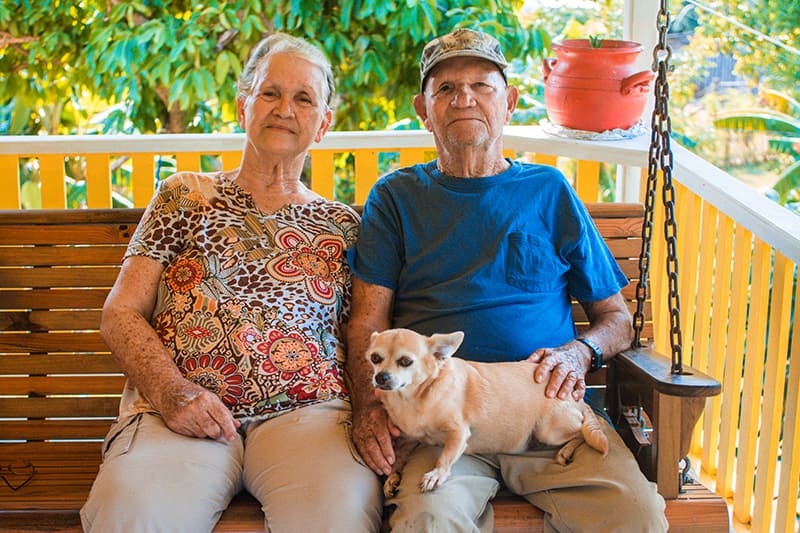
Mrs. Jessie Cooper on her porch of her Oak Ridge home.
Mrs. Jessie Cooper Preserves the Collective Memory of Oak Ridge
While families and friends helped each other out, the only Hondurans she ever encountered were the teachers at the Francisco Morazan School in Oak Ridge. “I didn’t want to learn Spanish and I still don’t,” says Mrs. Cooper. Oak Ridge had no roads, there was no police, no tax men, no Honduran military. “My father’s family wouldn’t allow Spaniards to land here until the 1950s,” recalls Ms. Cooper.
“Every Wednesday we would do embroidery and every Saturday there would be a dance. There was music everywhere,” recalls Mrs. Cooper.”Music is what I miss the most.” When she was 16, Mr. Hugh Parry, from England gave her a Brownie camera. The young girl put the camera to good use documenting happenings on the Cay.
-

- Jessie Cooper with friends.
-

- Cooper & Warren token used to pay island workers and was redeemable at the Warren and Cooper stores on Roatan. (Courtesy of Neil Keller)
She remembers an American seaplane that landed in Oak Ridge in 1942 investigating reports of islanders selling fuel to German U-boats. “They came in very low, skimmed and landed in the mangroves. People pulled them out,” remembers Mrs. Cooper, “the boat was so heavy and stuck in the mangroves so deep it had to drop a bomb in the 4-5 feet of water for it to be freed.” A PT boat, torpedo-armed fast attack craft, from an American Naval base at Puerto Castilla soon came to help. Mrs. Cooper remembers a serviceman who then agreed to fly on top of the wing in order balance the plane. “He fell in the water as the plane was launching. He got bruised up,” says Mrs. Cooper who documented the entire episode with her camera. After that came the occasional, but memorable visits by American officers stationed in Puerto Castilla.
While there was no rationing, food supplies were short. “We used to make war cake: no eggs and no butter,” Mrs. Cooper remembers. Coopers owned land from Jonesville to Diamond Rock and people would bring her vegetables, fruits. “It was a sharecropping system.” There was very little money circulating back in these days. One coin that was in use was a metal “Cooper coin” that the family had to be redeemed at their stores. The Cooper’s farm produced many fruits, vegetables and had cows, pigs, chickens and deer.
Life on the island, away from urban areas and many advantages of technology and medicine brought hardships as well. “I was eight months pregnant and had to go to La Ceiba,” remembers Ms. Cooper. Coming on the Edith-Mac boat from Coxen Hole to the coast was an all night affair. The boat transported cattle, cargo and people. “I had to lie down on dock on two Coca-Cola cases,” remembers the Mrs. Cooper, reflecting on the arduous passage.
Married for 21 years to Mr. James Cooper she had three children: Larry, Walton and Alana. Today Mrs. Jessie is a happy nonagenarian who loves spending time with her daughter Alana. She is energetic, fit and full optimism.

Mrs. Jessie Cooper with younger sister in 1930’s.