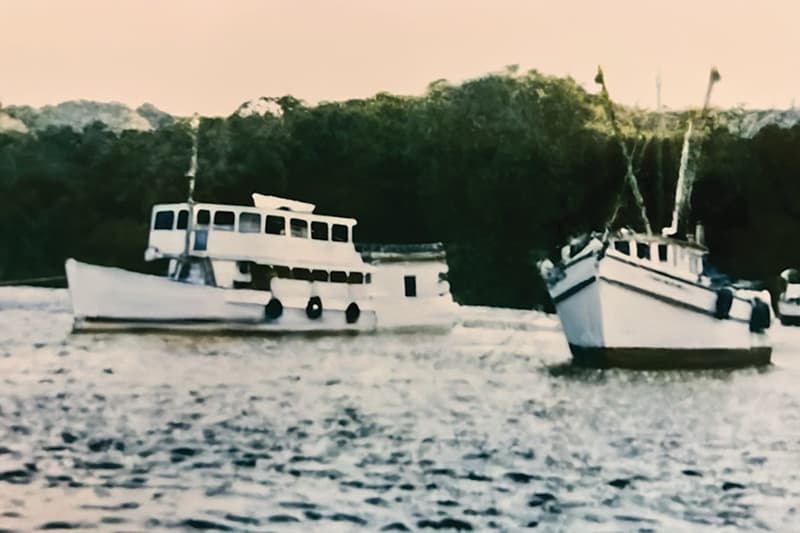
“That Northern is still blowing out on the shrimping grounds and shrimping boats are anchored up for three days now, sheltering behind Bogas Keys (Cayos Vivorillos). My brother has his anchored shrimper there. While talking to him later, on the Side Band radio to get an update. “There is a tropical wave developing in the Eastern Caribbean, heading northwest, and getting stronger. Got to keep an eye on that,” he said.
One of the reasons for the close attention paid to the weather has been the maritime nature of the livelihoods of so many Bay Islanders. The islanders find it important to know what loved ones working at sea are encountering in real time or what they might encounter in the coming days or weeks.
Another reason is that the Bay Islands have had its share of hurricanes, most recently with Hurricane Lisa. Some hurricanes that have hit the Bay Islands have also been very destructive, among these Hurricane Mitch in 1998, Hurricane Fifi in 1974 and Hurricane Francelia in 1969.
Decades ago, current weather and past hurricanes were a common topic amongst the islanders. Growing up in French Harbour in the 1970s, Francelia and Fifi were often spoken of anecdotally. My memory of which hurricane belonged with which anecdote is rather blurred.
I remember there being three separate structures on higher ground where entire French Harbour families sought shelter during Francelia and Fifi. These included the Seventh Day Adventist School and the home of Mr. Allan and Ms. Yvette Hyde, both located just to the South of the French Harbour cross-roads. The third was the small home of Ms. Minnie Jackson, which was located on the high ground on the North side of the canal that runs from the lagoon to the harbor.
Men remained in the yard and tied themselves to coconut trees.
Ms. Minnie’s home, during Hurricane Francelia, was so packed with children and their mothers that a number of the men remained in the yard and tied themselves to coconut trees.
Before arriving at Ms. Minnie’s, my father had been delayed at the harbor where he had gone to secure the Boy Laguna, the steel-hull shrimper which he captained at the time. It was then that our neighbor, Mr. Christopher Jones, helped my mother take her children to Ms. Minnie’s home.
My older sister and brother recollect the saltwater reaching their knees as they made their way down the French Harbor Street. They cut through the alleyway between the homes of Mr. Robert Arch and Mr. Algie Jackson. The alley led to the small wood bridge across the canal, which was located some 200 feet east of the current bridge. The alleyway was lined with oleanders being punished by the winds.
Following the hurricanes, there was always the tasks of going back into town to assess the damage. A potable water tank washed off its stilt platform and lodged underneath the house across the street, where it had broken away some of the house’s posts.
In the hole left by one of these posts we found a large red snapper swimming in circles. There were some changes with the shoreline as large deposits of clean, white beach sand ended up on the French Harbor Street. That sand was later claimed by Mr. Charlie Hyde, whose home was on the seaside of the street. Patiently, he wheel barrowed away all that he wanted.