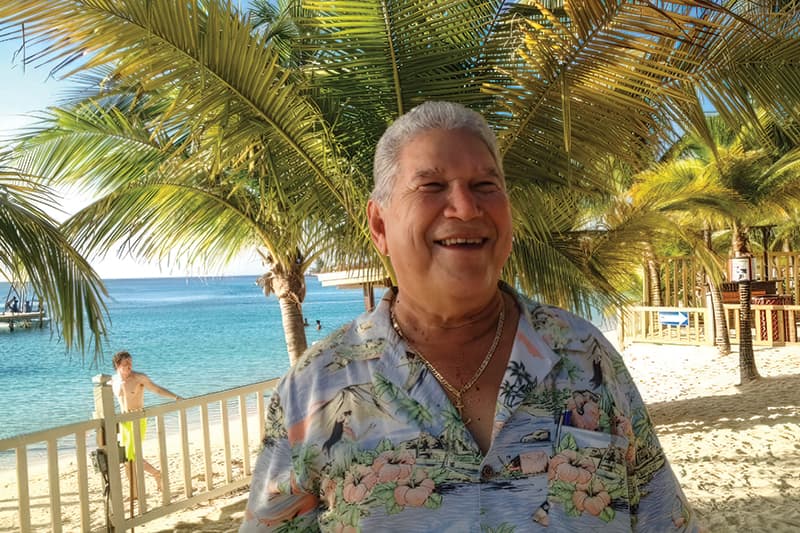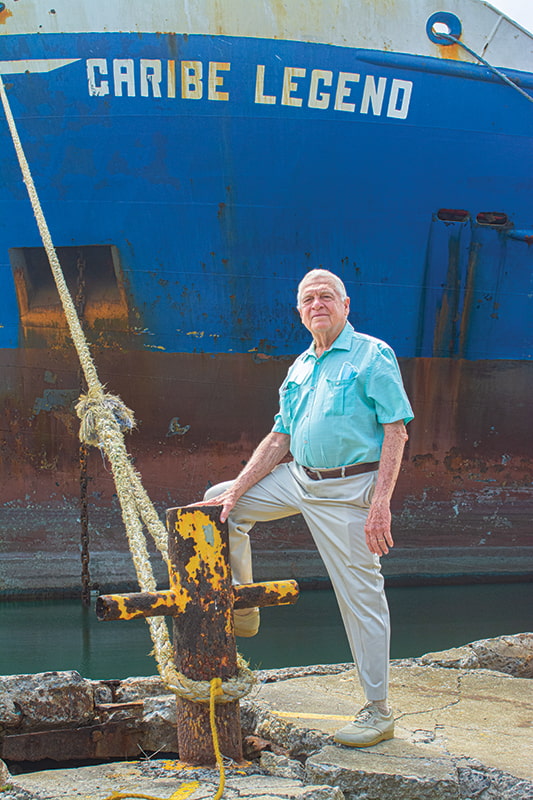
Cecil Kern Hyde Elwin was born on January 16, 1942 in his French Harbour parent’s home. Mrs. Dora Cooper, of Oak Ridge assisted with the birth. Little Kern was the third of four children. He had two older brothers: Mead and Allan, and a younger sister Judy Ann.
Kern, like other students, would walk barefoot to Mrs. Vera’s school, where he completed five grades. He would also attend the Honduran government school in the mornings. At 13, little Kern was sent to study in La Ceiba at “Los Hermanos Unidos en Cristo” that would later become known as Bethel Institute.
Mr. Kern spent time in La Ceiba when the town was thriving as a banana company town, one of the biggest such towns in Honduras. In the 1950s, La Ceiba was small, colorful and full of life. Standard Fruit company created its own self sufficient world with schools, churches, and a bowling alley.
Wednesdays and Saturdays were the mail delivery days.
At the time, the only link between La Ceiba and the rest of Honduras was the narrow gage Standard Fruit railway that weaved its way to Tela. Travelers venturing further would spend the night there and continue via the narrow gage of United Fruit railway to San Pedro Sula. These railways offered first and second class seating.
Back in Roatan, young Mr. Kern started helping his father with the family business – sea fright. The family’s workhorse vessel at the time was Judy, an 85 foot schooner built by Hersel Elwin. She would sail loaded with coconuts from French Harbour to Bonacca, pick up more coconuts there, and continue on to Miami. Sometimes the boat would go only seven miles an hour, arriving in the US after four or five days. On the way back Judy would bring US produced supplies for supermarkets in the Cayman Islands and finally return to French Harbour. The cycle would repeat itself every three weeks from August to January, when coconuts were most plentiful.
While working on Roatan Mr. Kern enrolled in a correspondence course at the American School in Chicago. He completed 16 educational units and received a coveted high school diploma.
The postal system was the lifeline for islanders back then. The mail offered a way to stay in touch with family in the US and communicate with businesses on the mainland. In the 1950s, the important title of French Harbour postmaster was carried by Tyson McNab. He had a room in the back of his home that would serve as the post office, available to weigh letters and sell stamps. Wednesdays and Saturdays were the mail delivery days, when a boat would arrive from La Ceiba. Mail was both efficient and affordable. An airmail letter mailed on Monday in Florida would arrive on Saturday on Roatan.
Mr. Kern’s passion and adventure with a video camera began when he was on a visit to Tampa in 1960. He purchased an 8mm Bell & Howell movie camera. From then on he began documenting the family and island life.
At 19, in 1961, Mr. Kern was appointed a captain on Judy. Not long after Mr. Kern switched to captain, the 120 foot long boat Altier that was both bigger and faster than Judy.
Young and handsome, Mr. Kern married Ruby Nood, a young lady he met at the Blue Wave bar on the Bonacca Cay. He was 21 years of age. The couple built a home in French Harbour and had four children together: Lisa, Jed, Joni and Jenna.
At 23, during Christmas 1964, Mr. Kern found himself with Altier in the Bahamas delivering a cargo of yucca. His crewmen were using gasoline to clean an area when a spark ignited a fire. The fire quickly spread through the entire ship. As the floor of the burning Altier gave way, one of the shipmates caught the arm of Mr. Kern and pulled him up to safety. The young captain almost lost his life.
The Hyde family was always looking to expand their family business. The year 1965 provided an opportunity to get into the shrimp business that was booming in Western Caribbean, and the family purchased two shrimp boats to get their feet wet. Their business peaked in 1978, when the Hyde family managed a fleet of 23 fishing boats.
Mr. Kern remembers the first investors who saw their future on Roatan: Roy Anderson on the far East end of Roatan, Harvey Mayer who opened an ice plant in Oak Ridge, and Mike Hold bridge in French Harbour.
As an energetic octogenarian, Mr. Kern spends his time between Roatan and Florida. Since 2010 he has worked at Hybur, the Hyde family business, in an advisory capacity. Mr. Kern feels most proud to have worked with his family.