The commandant asked the men to volunteer for the build. While there would be no pay, their room and board would be covered. Some of the men volunteered, while others did not. So the commandant put those who refused to work to work anyway.
He asked who in the group was a carpenter and whether they could put a roof on the buildings. Those who said they could do the job were put to work directly on the buildings. The non-volunteers would not disclose what skills they had, so the commandant assigned them to the Coxen Hole to West End road being built at that time — by far the harder work. They had to carve out and level the road using only shovels and hoes.
My father, Archie Jones, was part of the group of men who volunteered. The next day, the commandant delegated duties to each of the men working on the buildings, matching each man’s skills to his job. My father was a painter and a seaman by profession.
The men worked the first week fully, and once the week was done, the commandant let them go back to their homes. Only about half of them showed up for work the following Monday. The commandant was annoyed, as they had all promised to return, so he sent the soldiers out looking for them. They caught a few of the men who had deserted, while others hid in the bush. The ones he caught were put to work on the hardest part of the road construction as punishment, and he did not let them go home the next weekend.
They caught a few of the men who had deserted.
My dad told me that he spoke to the commandant himself. He explained to him that he had a wife and children, as well as a farm. He was willing to do the work, but he needed to leave by 3 p.m. each day to tend to his duties to his family and his farm, and he would return by 8 a.m. the next morning.
The commandant agreed to his proposal, but warned him that he had better keep his word. The commandant had seen my dad work and was greatly impressed by his skill at painting, so he instructed him to paint the entire building — a job that took about two months to complete. Their deal stood strong the whole time.
Several other men made their own agreements with the commandant. For those who did not, a rift grew between the men and the commandant, and some ran off in the night. Eventually the structures were finished and painted. One building was the two-story cabildo and the other housed the commandant’s office, the governor’s office, the judge of letters’ office, the post office, and the customs house.
Burning of the dories
I should point out that at this time, not many islanders spoke Spanish, and as time went on, more disagreements arose between the islanders and the commandant. Another example of this rift was when the commandant issued a new law not allowing horses within the main street of Coxen Hole due to the waste. This caused issues, as most transport of goods was done by horse. Islanders were forced to leave their horses on the outskirts and walk with their items to sell.
The commandant later accused the islanders of smuggling merchandise off the ships that came from Mobile, Belize, Florida, and elsewhere. The merchandise was supposed to arrive at the main dock in Coxen Hole, but the men were accused of going out by dory, off West End, to take a portion of the goods from the ships before they could pass through the customs house. The commandant used to say, “These islanders would smuggle under the nose of Jesus Christ.”
The commandant decided he would go to West End and burn up all the dories. Someone tipped the islanders off to his plan. The islanders hid all of their good dories in the mangroves, sinking them with rocks and water so they would stay submerged and out of sight. By the time the commandant arrived, he found only some old dories that the men had placed there as a diversion. The commandant ordered his soldiers to pile up the old dories and burn them all. He suspected the island people had pulled a trick on him, since there should have been many more dories — but he decided this was enough to send his message and put a stop to the smuggling.
A woman, a dog, and a local
Around this time, a yacht arrived in Coxen Hole, and her owner was a woman. The boat stayed for some time in an area called Close Harbour, located near where the west end of the airport sits today. The commandant and the woman became close friends.
The woman had a dog, which she would bring ashore around the park each evening. The locals also went to the park in the evenings. On one occasion the dog bit a local man very badly and he ended up killing it. It was reported that this dog had bitten several other people as well.
The woman complained about the killing of her dog to the commandant, who responded by sending soldiers to arrest the local man. They beat him with a bullwhip as punishment. The local man had confided in a friend that he planned to take revenge on the men who beat him. His friend convinced him it would be safer to go than to stay and risk further trouble with the commandant. He later moved to the U.S. Once the commandant vacated his position, the local man returned to the island.
The complaint to the president
A group of islanders decided to travel to Tegucigalpa to submit a formal complaint against the commandant. It was 1944 and they met with General Carías, who was president of Honduras at the time. Gen. Carías listened to them and told them he would relieve the commandant of his post in Roatan and relocate him elsewhere. The general also told the men that he would be sending a new commandant — one he knew personally — and warned that if the problems continued, he would look upon the islanders as the cause.
Colonel Ernesto Cruz
The commandant’s replacement, Colonel Ernesto Cruz, arrived on the island in 1944. In 1945 he brought a secretary to work alongside him, a man by the name of Rafael Moya. The colonel got along very well with the islanders and was well liked by everyone. The Gough brothers in Oak Ridge built a boat and named her after him: the “Colonel Cruz.”
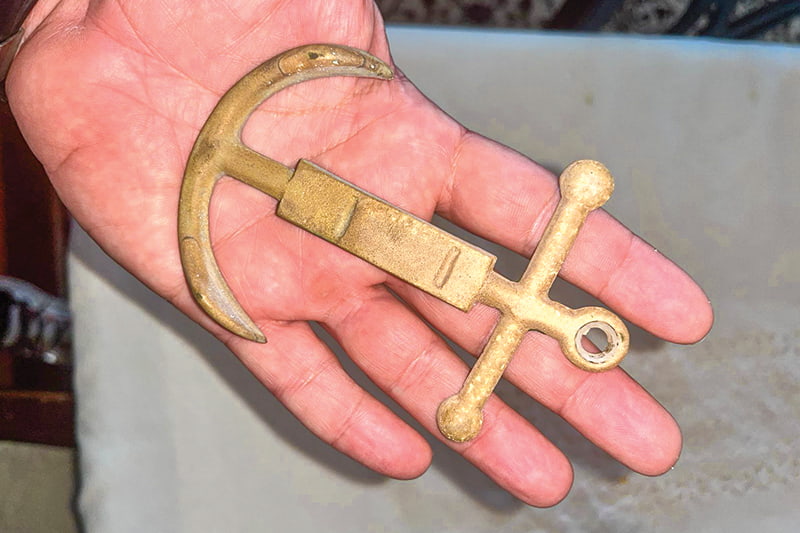
Rafael Moya married my sister, Caroline Jones, in 1951. As a boy of six, I spent a great deal of time in Coxen Hole with my sister between 1951 and 1955. I would stop by the colonel’s office a couple of days each week. He kept a paperweight on his desk — a brass anchor — that I used to play with whenever I visited.
When the colonel finished his tenure in 1956, after 12 years in Roatan, he returned to the mainland. Before he left, he gave me that brass anchor and told me to anchor my own boat down with it once I got one. I always planned to visit him when I became a man, but I was never able to make the trip. He later died on a farm outside of San Pedro Sula. There are still descendants of Colonel Cruz living in the Coxen Hole area to this day.
I still have that anchor. It hangs in my den at my home. I often look at it, reminiscing about those years.