The trick was to first grab both sides of the dory and launching oneself out of the water with a firm kick of the flippers (fin-foot) while swinging your rear-end (bonke) on to the seating plank (thwart – pronounced ‘tort’). An experienced diver or dory man could perform this movement without his companion even feeling a shift in the equilibrium of the craft! Of course there were those that could never master dory skills and who would be forever teased and berated by the experts. I made sure to practice and become skilled but it wasn’t after being called marble-bonke and crankey a few times.
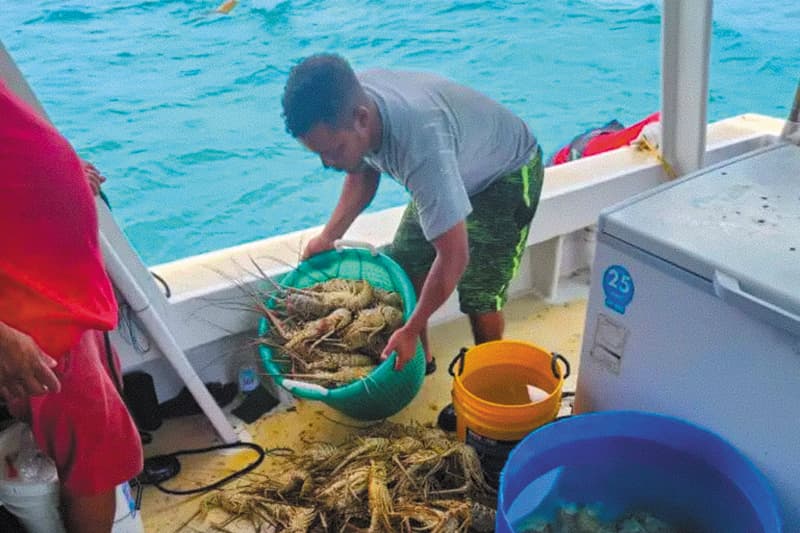
The freedivers made hay while the sun shined but of course with the demand for lobster tails and more and more boats out on the banks and more divers around the islands (Bonaccians had jumped on the bandwagon and were producing some very talented young divers as well as Calabash Bight, Fiddler’s Bight and Punta Gorda down the shore on Roatan), lobsters became scarcer and were living even deeper.
Only very skilled and experienced freedivers who had memorized their special holes could come up with a decent payday. There were special quirks and inside knowledge to lobster diving; A diver looking down at coral rocks from above would see the sand whiter and cleaner with maybe a few shell fragments at the mouth of a rock crevice where a lobster was living; of course if a lobster was in a crevice and fending off small fish it would wave its antennae (whips) to reveal its location to the diver who would be snorkeling above.
There were fatalities and injuries.
Tanking started to be practiced by the Helenians in the 1990’s following the Miskito Indians (Waikna’s) lead. But this was barebones tank diving, no buoyancy compensator (BC), no depth guage and no pressure guage! I learned to tank dive like this and was taught, just like I was taught to freedive by the best Helenian divers and the critical advice was 1. When the tank started to make a ringing sound it was getting empty and it was time to come up. 2. Never ascend faster than the speed of your bubbles and 3. If the air in your tank finishes on your way up don’t hold your breath but exhale as you float (not swim) to the top.
Needless to say there were fatalities and injuries with a few young men left to live the rest of their lives, bedridden or in wheelchairs, if their families could afford it.
Diving on Helene is still a way of life, both freediving and tanking; in fact there are a few small locally owned boats that venture out to the banks and do quite well nowadays with the implementation and observance of a Lobster season. Freedivers do well at places like Alligator Reef and Half Moon Reef (located about 70miles East of Barra Patuca) where the lobsters are in relatively shallow waters. Rich lobster producing banks and reefs like Quita Sueño (150miles east of Puerto Cabezas), once frequented by Bay Islands boats and Miskito and Helene divers are now too far to travel to with the cost of fuel and fuel range of small boats prohibitive, not to mention the advanced technology of GPS surveillance which limits Honduran vessels to remain in national waters.
I was fortunate to have lived this life for a couple of years living in Saint Helene, I was accepted by this community and my curiosity was rewarded by these humble yet very tough folk who taught me, unselfishly, all the skills I needed to survive and live the very basic life of a Helenian. I did a few trips out on the fishing banks, the first of which was on a small 60ft wooden hull called the Lady Hilda skippered by the owner Charles Tatum (popularly known as ‘Uncle Pete’) who confidently navigated his vessel hundreds of miles from these islands placing the boat at exact points with just a compass, an old maritime chart yellow with age and a VHF radio. No Loran, no Satnav, quite incredible but we trusted him implicitly. But that’s for another story!