


Kilotonnes of Seaweed become a Curse to Many, a Resource to a Few
You can look at the Sargassum overabundance as a curse, and you can also look at it as a blessing. In February, when millions of cubic meters of Sargassum washed onto beaches and mangroves along the Roatan shoreline, many islanders took action. Others did nothing at all. After two months, the results are in.
The winter of 2026 broke records, creating a Sargassum bloom never before seen at this scale in the western Caribbean. The 2025 Sargassum biomass was estimated at 37 million tons, but this year will surely smash the record once the tally is in.
The extraordinarily large bloom is attributed to wind-driven upwelling in the Atlantic, which brought extra nutrients to the Sargassum belt.
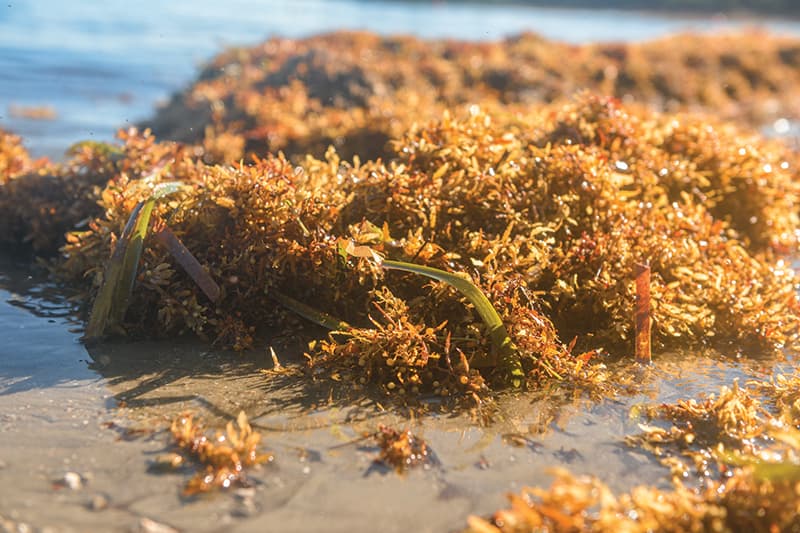
On Roatan, two species of Sargassum have wreaked havoc: Sargassum natans and Sargassum fluitans have been washing up. Sargassum is a type of brown macroalgae, or seaweed, that grows in the Atlantic and is pushed eastward by wind onto the shores of islands and continents. Things get out of hand when Sargassum quantities become 50 or 100 times greater than in a typical year.
The Sargassum Impact
Sargassum disrupts ecosystems, creates a foul odor and traps tiny fish. The seaweed depletes oxygen in the surrounding water. As it breaks down and decomposes, Sargassum produces hydrogen sulfide and ammonia, resulting in a low pH level. This further harms the aquatic environment and the animals that live there. The result is the creation of dead zones under and around floating, decomposing Sargassum.
In other words, Sargassum degrades water quality and makes the marine environment inhospitable. The number of species and the density of marine life drop. Once Sargassum leaves the island’s coast, the true scale of those negative effects can be assessed. When Sargassum envelops mangrove areas, it also stifles local fish species that use mangroves as nurseries.
Another negative effect is the microplastics that are brought in by the Sargassum. The pieces of Sargassum float hundreds of meters from beaches, and swimming or snorkeling can be a less pleasant experience.
There are a few benefits of this seaweed for critters that feed on it. Sargassum provides a rich environment for organisms such as bacteria and fungi, which grow on decomposing plant matter, breaking it down and turning it into nutrients. Some fish, including juvenile triggerfish and filefish, feed on the invertebrates that live with the Sargassum. Tiny amphipods and isopods graze on the decaying Sargassum, and those, in turn, become food for crabs and fish.
There are examples of such events in the recent past. In 2018, Mexico’s Caribbean coast was so inundated with Sargassum that it caused a die-off of dozens of animal species. This year, Sargassum has overwhelmed Roatan’s beaches, and the island’s marine life has been hit hard.
While Roatan is about 42 kilometers long, its meandering shoreline stretches well over 160 kilometers. Tens of millions of cubic meters of Sargassum have washed ashore on Roatan.
WEST BAY UNDER SARGASSUM SIEGE
On Feb. 9 and 10, the situation got out of control. As rainy weather kept most West Bay tourists from going to the beach, Roatan’s premier beach shore was packed with Sargassum. West Bay, the jewel of Roatan tourism, has been affected as never before. The 1,000-meter-long beach was surrounded by a belt of Sargassum that was 100 meters wide and half a meter thick.
Local authorities became preoccupied with solving the immediate problem of Sargassum affecting the beach experience for thousands of tourists visiting the jewel of Roatan. They felt they needed to act quickly, and that solution was to truck the Sargassum to dumping sites across the western side of the island and bury the rest under the white beach sand with heavy machinery and plenty of manpower.
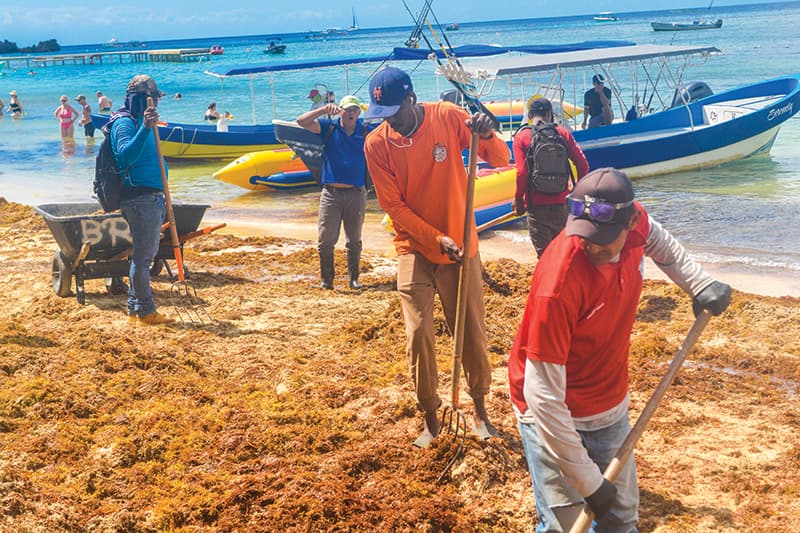
Sargassum has been racked by hand by dozens of municipal workers, wheel barrowed onto trucks and dumped by the side of West Bay Road and at the municipal dump. Paya Magazine calculates that more than 300,000 cubic meters of Sargassum were removed from West Bay Beach in the winter of 2026.
While covering tons of Sargassum directly beneath two meters of white West Bay sand seemed to solve the aesthetic problem in a matter of days, as with many quick decisions, the unintended consequences might take several months or years to be realized. “Burying the Sargassum on a white sandy beach like West Bay can result in changing the color of the sand over time,” said Darrell Humphries, HOA manager at Palmetto Bay since 2016. “If you start placing Sargassum there, you can end up with darker, browner-colored sand eventually.”
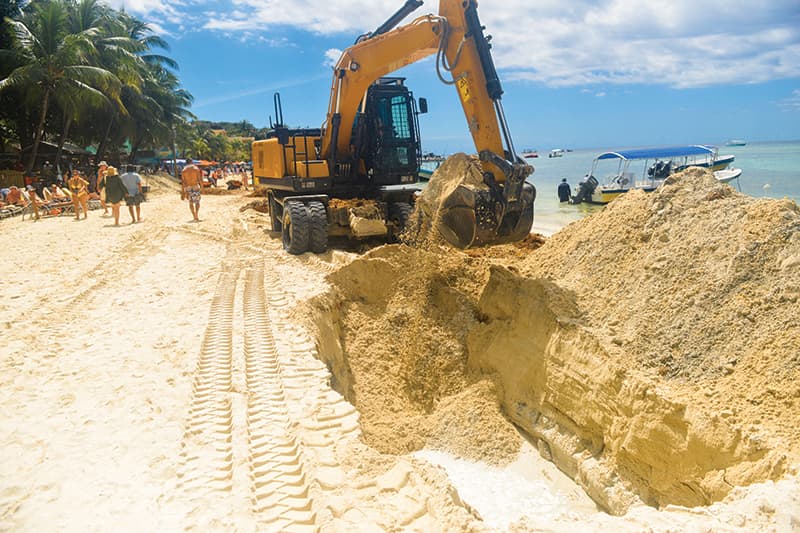
A municipal heavy equipment digger extracts a sand pit in order to bury the Sargassum. 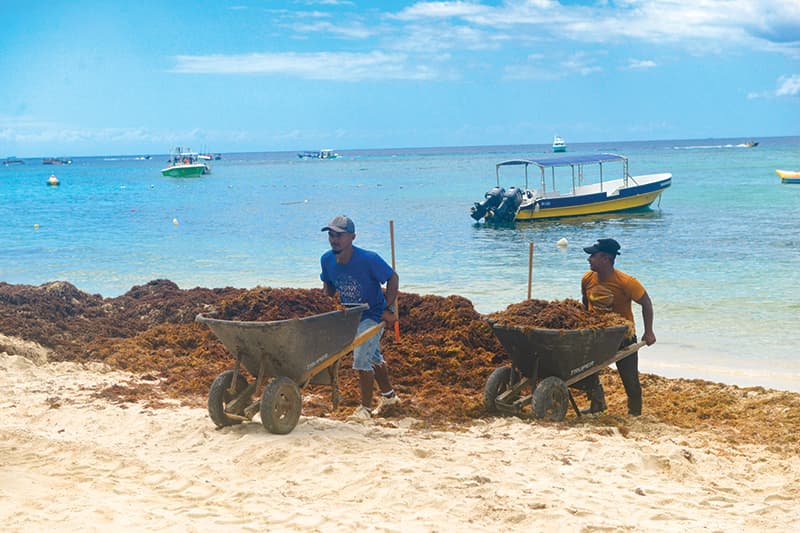
The Roatan Municipality workers have stepped in to move the beached seaweed way from the beach. 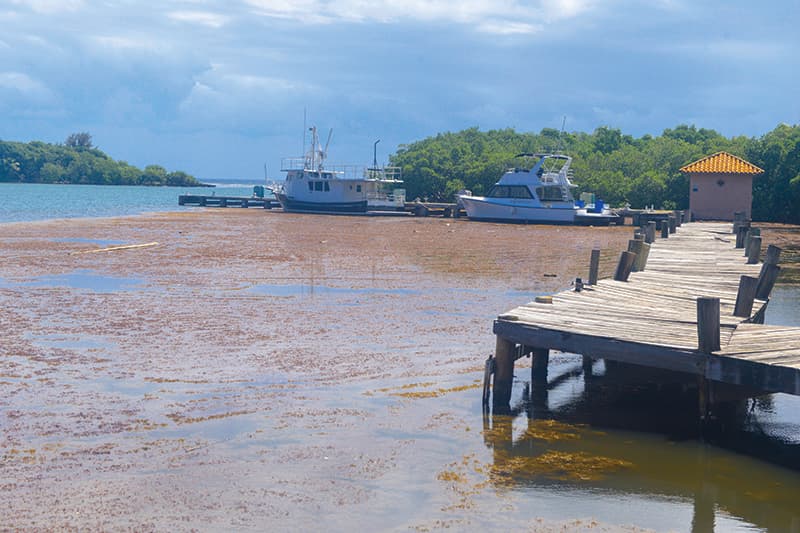
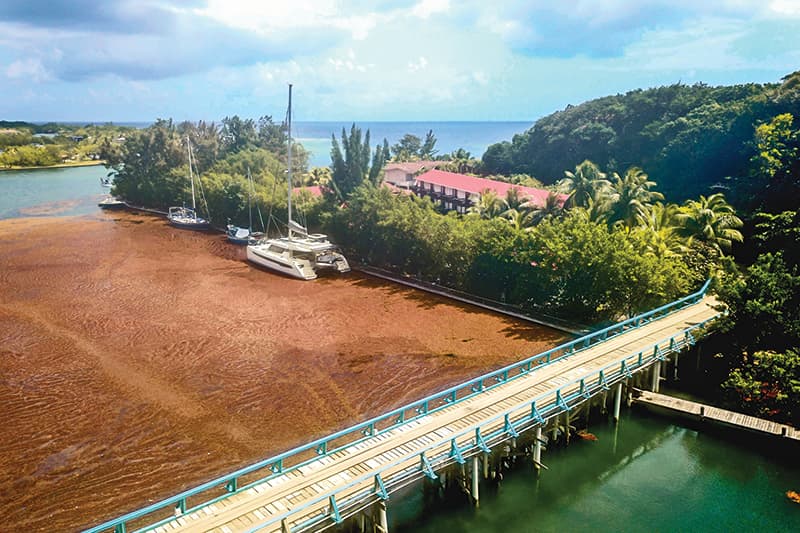
Parrot Tree marina in Second Bight has filled with decomposing Sargassum. 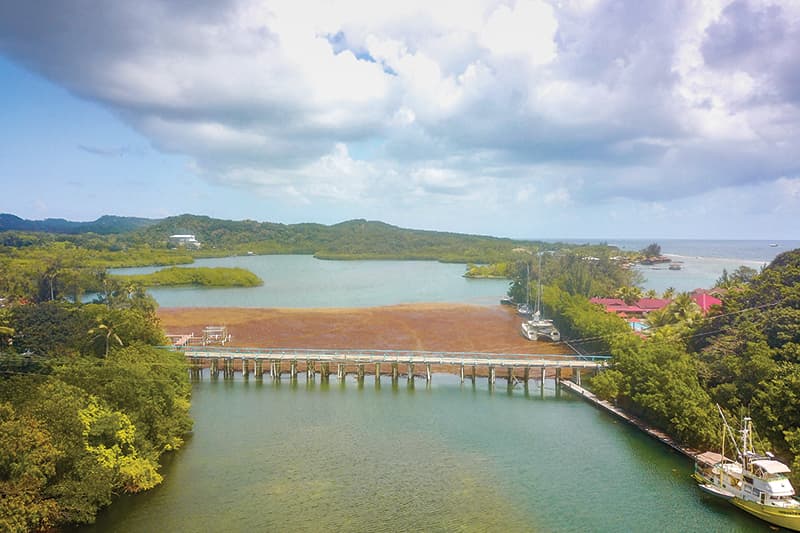
The bridge to Ezekiel Cay serves as a barrier to Sargassum.
According to Humphries, turtle grass and spaghetti grass, with their high calcium content, eventually turn into sand, but Sargassum turns into a solid, darker material. “Sargassum is a darker type of product once it is broken down,” Humphries says. “It’s empirical, a lot of observational stuff we have learned over time.”
Another potential unintended consequence of burying Sargassum under a relatively narrow and steep West Bay Beach is the potential to speed up beach erosion. While burying Sargassum along West Bay Beach has given beach users a wider and taller beach, that effect could be only temporary.
Sargassum blocks sunlight reaching both coral and sea grass.
The higher beach will erode more quickly from currents and storms in the coming months, and perhaps a year or two. The waterlogged, spongy Sargassum will eventually be compressed into a minuscule layer of brown solids. When the currents finish their equalizing work and the Sargassum compression process ends, West Bay Beach might be narrower and lower. The beautiful beach might be less wide after Sargassum floated into West Bay in February 2026.
BEYOND WEST BAY
While the attention of Roatan Municipality authorities focused resources and manpower on tourist areas such as West Bay and West End, the rest of the island was left to fend for itself. The communities of Punta Gorda and Brick Bay were particularly affected by the tons of decomposing, foul-smelling seaweed.
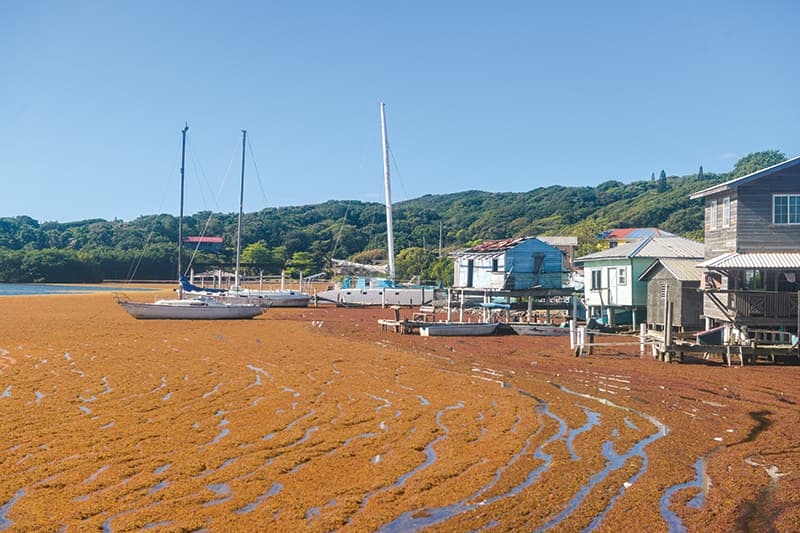
Some places have had it worse than others. In the Brick Bay community, the Sargassum has been accumulating and decomposing for more than six weeks. Several hundred people live in this densely populated south side seaside village.
As older seaweed decomposes, new waves of Sargassum wash ashore, replacing it. The stench of rotting Sargassum is similar to that of a failed septic system. While no one has become ill, constant exposure to the stench of decomposing Sargassum has been stressful and miserable. “People are getting accustomed. In their homes, the smell seems less strong,” said Ricardo Hernández, a longtime Brick Bay resident.
The Honduran Navy has considered bringing in a floating barrier to prevent more Sargassum from floating into Brick Bay. The most likely outcome is that the problem will solve itself naturally. Nature will take away what nature has created. “We are waiting for a northern that would move the Sargassum out to sea,” says Hernández, whose Brick Bay home is 15 meters from the sea.
SARGASSUM AS A RESOURCE
When life gives you lemons, make lemonade, goes the proverbial phrase. The ideal situation would be to treat Sargassum as a periodic resource: a fertilizer, a building material for roads and landfills, and even an element for creating building blocks.
In Mexico, local entrepreneurs have found a way to turn Sargassum into a construction material. They gather Sargassum from beaches, and then wash it with fresh water to remove the salt. Next, the Sargassum is dried and shredded, and a cement mixture is added. The rectangular Sargassum building blocks are then dried in the sun. The resulting Sargassum-cement blocks are strong, fire-resistant, thermally massive and inexpensive.
On Roatan, some islanders have been using Sargassum as fertilizer for well over a decade. They pick up the seaweed from the beaches, rinse it with fresh water, and then spread it around the base of their fruit trees. “We let it dry out and put it all over the plants,” said Richard Anderson, a hotel owner from West End. “It’s like Popeye when you give him spinach.” Anderson rinses the Sargassum and then dries it out before using it all over his property.
There are also islanders who use Sargassum as a construction material and landfill material. Over the years, the Palmetto Bay maintenance staff has become expert at quickly gathering Sargassum from the beach and using it for improvements in community areas.
Islanders have been using Sargassum as a fertilizer.
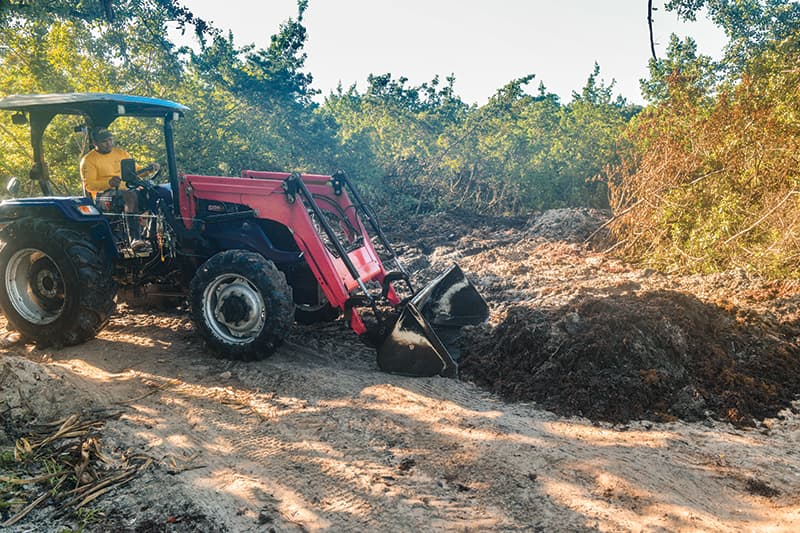
Palmetto Bay maintenance staff has been using washed-out Sargassum, turtle grass and spaghetti grass to construct a walking trail and road system in its low-lying Bird Sanctuary community area. This project began in 2014, so the Palmetto Bay HOA staff has gained extensive experience handling Sargassum and using it in careful, strategic ways.
Palmetto Bay maintenance staff have been using Sargassum as a natural, free fertilizer for some of their plants. “It’s a great fertilizer; it’s great for mixing in with regular soil,” says Darell Humphries, manager at Palmetto Bay.
The steps in producing this free plant stimulant are minimal. Workers gather the Sargassum with a tractor, place it on a trailer, and dump it in an area where rain rinses it down. Then the Palmetto Bay staff places the broken-down Sargassum at the base of plants and trees. “Peppers and other vegetables do very well with Sargassum,” says Humphries.
The maintenance tractor operators try to avoid picking up Sargassum that has rolled around in the water and become entangled with a lot of sand. They try to keep picking up Sargassum and keeping the entangled sand to a minimum, somewhere around 5% to 10%.


