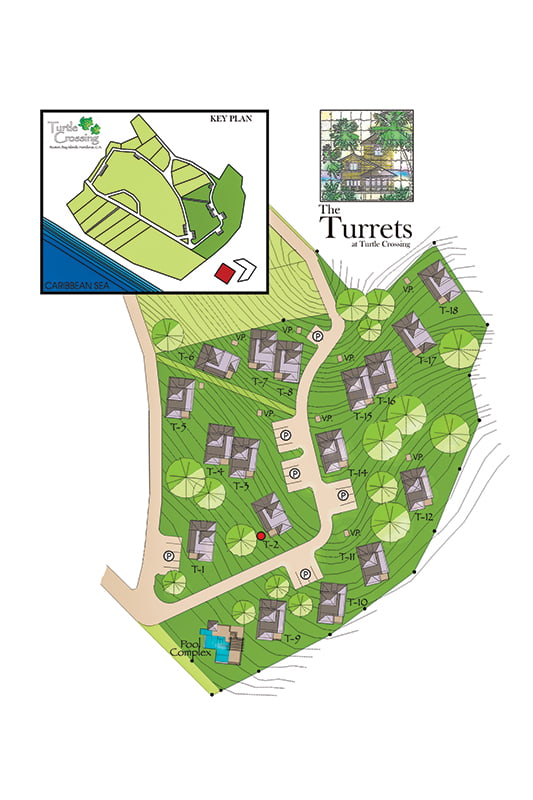
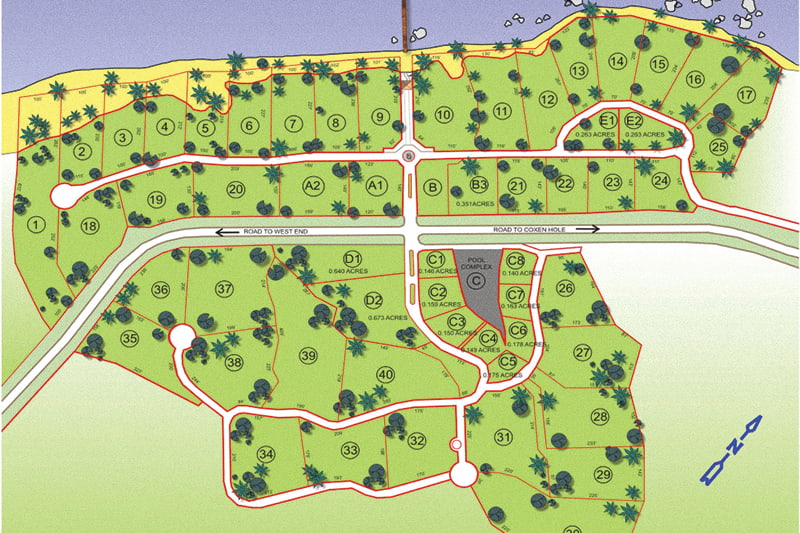
Hal Sorrenti’s architectural plans for Turrets West Bay housing development.
Island Housing Development’s Past and Future
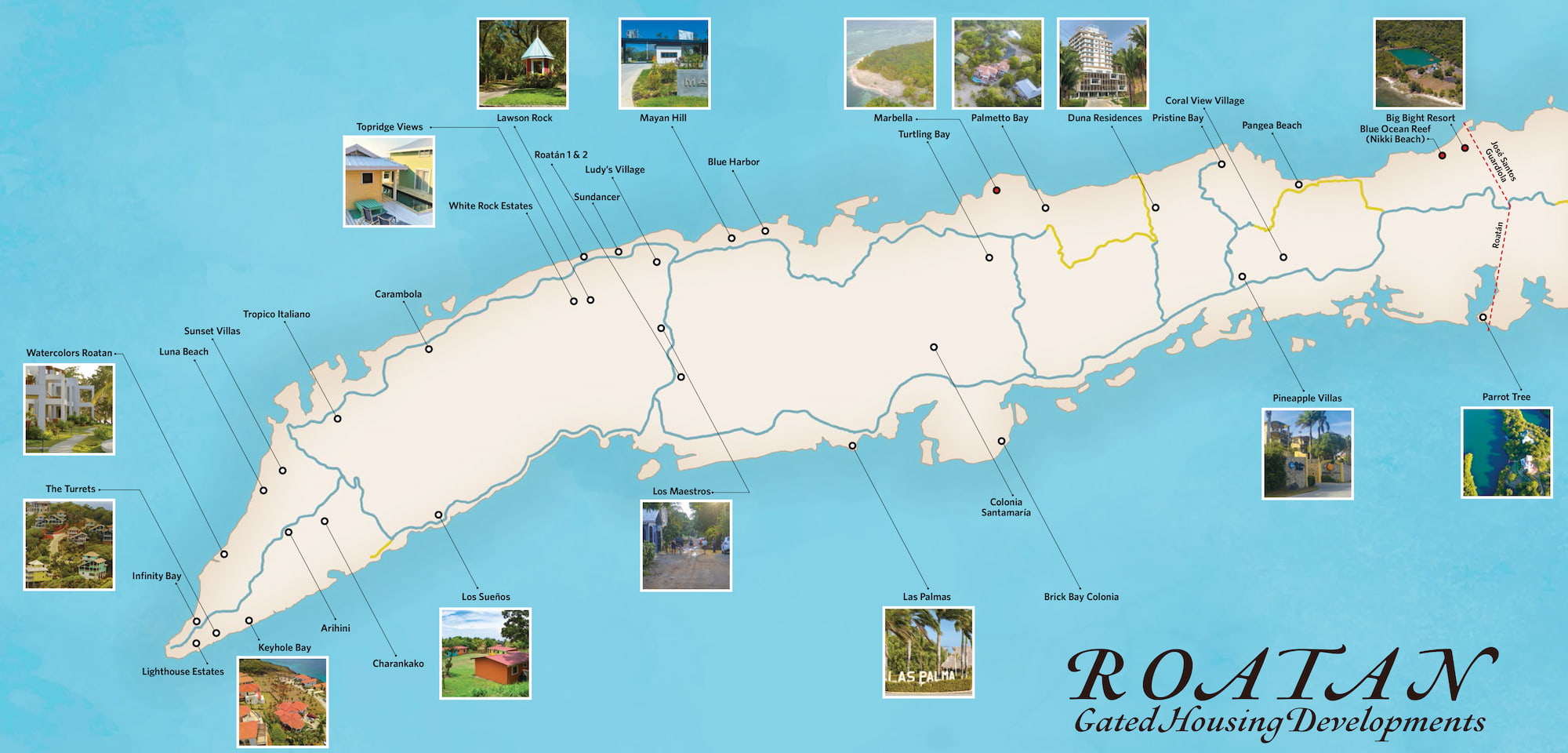
The business of developing housing units on Roatan is booming. Roatan is already dotted with housing developments, as from the tip of West Bay to the end of Camp Bay there are over 70 housing communities. While the biggest ones like Coral Views Village, Parrot Tree Plantation and Lawson Rock have over 100 house lots each, there are plenty of small developments with as few as three houses.
Housing developments on the island come in all kinds of shapes and sizes. Mostly they are residential housing communities, but there are also condominiums, residential resorts and subdivisions. The construction trend is picking up. According to Steve Hasz, owner of Roatan Life Real Estate, there are approximately 12 new developments that broke ground since 2023.
While many of those are luxury and high-end projects, many are affordable and middle income. In general, gated housing communities in Honduras are not only for the wealthy and foreigners. In large urban areas like San Pedro Sula, Tegucigalpa and La Ceiba, all sorts of housing developments are surrounded by walls and their entry points are guarded. Roatan now has several affordable gated communities that were developed over the past few decades: Roatan Uno and Los Sueños are examples of some of those.
In fact, the first “not quite gated” Roatan housing development dates back to the 1980s. Preceding all of the gated housing developments is Brick Bay’s Colonia, a development started by Dr. Wesley Henwood. The development got a boost when Caribbean Sailing Yachts (CSY) resort was built on Roatan in early 1980s on land purchased from Dr. Henwood. The CSY resort already had a restaurant, a pool and security, so the owners of the houses in the colonia benefited from that.
Henwood’s project didn’t provide underground utilities and didn’t have Covenants, Conditions, and Restrictions (CC&Rs), a Home Owners Association or gated access. Brick Bay Colonia served as an example for others that came later.
These days a housing community being “gated” could mean many things on the island. A couple dozen communities indeed have a gate and a guardhouse at points of entry. Many, however, just have a watchman, or a watchman who doubles as a gardener, a pool boy and a beach cleaner. “Often a gardener would also clean the beach and take care of the pool. I’d call those ‘gated’ communities,” says Steve Hasz, owner of Roatan Life real estate brokerage.
The reality of living in Honduras is different than in the U.S., but increasingly less so. “In North America, I wouldn’t live in a ‘gated’ community. Here I have and do,” says Hasz, who has been living on the island since the mid-1990s. “Since the taxes are so low, the municipality doesn’t provide the same level of infrastructure and security that is provided in North America. Having good services and someone keeping an occasional eye on the neighborhood is a good thing and gives me peace of mind.” What attract people to the island is the climate, nature and culture, but what makes them build a home is the security.
In the mid-1990s Roatan was a different place. The beaches were virgin, forests unspoiled and plentiful. What were not so plentiful were paved roads, or heavy equipment and materials to construct them.
It took a few years for things to fall into place, but the island gradually became an attractive place not only for adventurous home buyers, but for more mainstream foreign and mainland homeowners. Roatan got its daily ferry connection with La Ceiba in 1994, an airport was opened in 1995, the road to West Bay was cut in 1992, and around 1996 Honduras’ National Port Authority (ENP) inaugurated a dock that could be used by cruise ships.
The mid-1990s was also the beginning of the housing boom for the island, and the first movers had an uphill battle. Housing developers that came to Roatan at that time were American, Honduran and Canadian. Those development pioneers were John Edwards with Parrot Tree Plantation and Mayan Princess, Ricardo Maduro with Big Bight Resort and Villas, David Sellon with Lawson Rock and Kent Owenby with Palmetto Bay Plantation.
Historically, many Roatan developers were not professional developers but people from all kinds of different backgrounds — doctors like Dr. Henwood and Dr. Don Goin, a retired surgeon; architects like David Sellon and Gary Chamer; Herb Morici, a telemarketing executive; and Kent Owenby, a banking executive. Hasz says that developers on Roatan come from many different backgrounds. “You have a mix of North Americans, Europeans, Guatemalans, Salvadorans, and mainland Hondurans,” says Hasz.
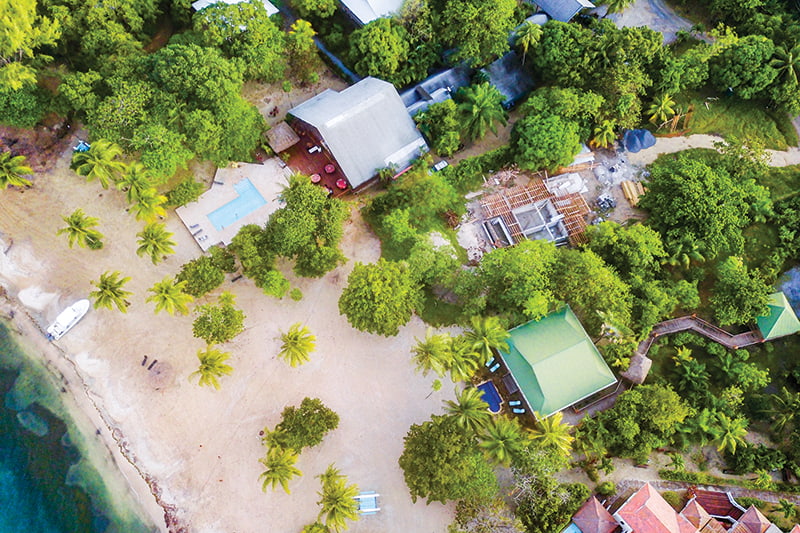
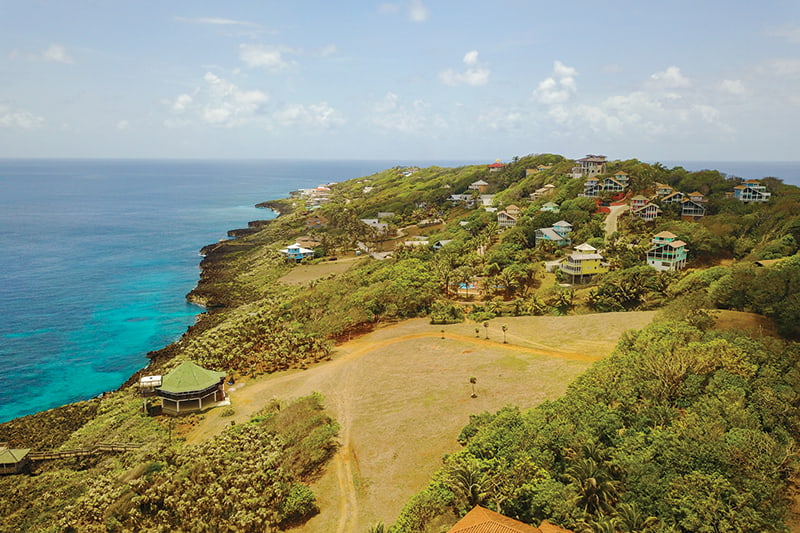
Aerial view of Palmetto Bay and its beach area.West Bay’s Keyhole Bay development begun in 2003.
Historically, developers have financed their projects themselves, with family capital or savings. They would start with their own money, then look for a Honduran bank to loan them additional funds. Subsequent phases of housing projects would be financed by sales of lots and condominiums. “Lawson Rock Phase 1 is an example of that, where all the first amenities were put in place at the developer’s cost, and then 40 of the first lots sold in less than two years,” says Hasz, who also lives and works in the development. “That system works much better because a buyer is not waiting on promised amenities like underground power, paved roads, pools, docks, etc.”
Mid 1990s was the beginning of the boom.
Hasz says that housing developers on the island can be divided into three groups: landowners trying to monetize their land, hospitality operators adding residences, and investors reacting to demand. Developers thrive, or fail because of financing. Many times, developments are financed by the developer initially putting in some funds and starting the development, then proceeding in phases and making improvements based on income from sales of lots and condominiums. Some developers who arrived on the island in the last 10 years are better funded and build infrastructure prior to first sales.
Over the last 30 years the success of developers of gated housing developments on Roatan depended on several factors. Sometimes it was just the timing of the project as far as the economy in the U.S. or a political events in Honduras. The 2008 economic crisis in the U.S. and the 2009 Honduran coup put a nail in the coffin of several housing projects. The government-imposed lockdowns of 2020 weren’t much help either, and many developers struggled. So it is sometimes luck, and often the skill and determination of the developer to handle adversity and stress over the long process of developing a project.
One of the more successful longtime Roatan developers is Henrik Jensen, a Dane who has lived and developed projects in Cayos Cochinos, Utila and Roatan since the mid-1990s. With Adam Gram, a fellow Dane, he developed Coral Views Village, a gated community that launched in 2014. His 120-acre, 240-house-lot project overlooks French Key and is by far the biggest such project on the island. Coral Views lots were originally sold for between $39,000 and $150,000. “First year alone we sold 80 lots,” Jensen recalls of the sales boom. He believes that the key to his success was not taking bank financing for the development.
Jensen is currently developing the Sanctuary project near Crawfish Rock and Sea Cliffs, a 120-lot development on Utila’s northern shore. As one of the veteran developers on the island, Jensen sees housing developments on the island evolving to offer a different product. “It will be smaller land lots, but high-end facilities,” says Jensen. “The infrastructure costs are too expensive.” Roads, culverts and underground power cost much more to bring to lots that are 0.15 acres than 1 acre.
Over the last 30 years a typical house lot in a development has gotten smaller. Since the 1990s land prices have risen dramatically, and that is reflected in the size of lots offered by developers trying to make a profit and keep lot prices affordable. There are some island developments that offer lots as small as 0.1 acre and as large as one acre. “Realtors typically recommend not going below one-fifth of an acre (0.2 acre), since lower density puts less pressure on our infrastructure,” says Hasz. The smallest lots barely leave enough room for a septic system.
While location is very important to the success of a development, island developments vary greatly in this regard. Some housing projects have been built on beaches at a considerable distance from main roads. Other projects are bisected by the main island road and are built on steep 45-degree slopes. Some offer sea views from home sites while others are more urban and offer limited views.
From a homeowner’s perspective, “a successful development will foster an environment of peace with little conflict and a sense of community for the neighborhood,” says Hasz. To attract home buyers, larger projects provide a host of amenities: beach access, community pools, a restaurant or a gym.
Many housing developments, to keep things orderly and preserve home values, have organized themselves into homeowners associations. “In general, developed HOAs here are not a profit center, but are a way for the residents to share costs to get better services,” says Hasz.
The basics, such as community wells, paved roads and underground electric power, come at a price, and homeowners have to pay a monthly fee — somewhere between $200 and $350 — to pay for security, water and maintenance.
There are also many island developments that have very low HOA fees, or even no fees at all. The homeowners in a community pay to fix roads or make improvements by contributing to a fund as those expenses arise.
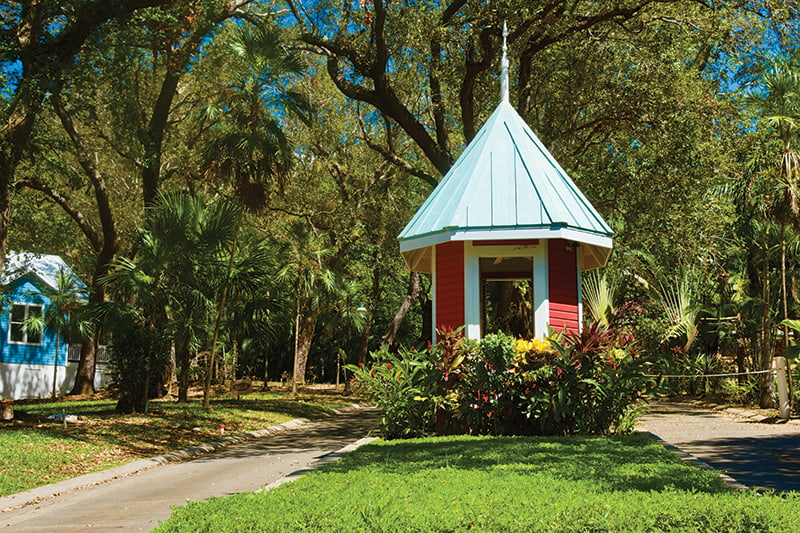
Seafront homes at Parrot Tree Plantation.Lawson Rock master plan. A guard tower in Lawson Rock designed by Hal Sorrenti.
After the initial wave of developments in the mid-1990s, a second wave of developers came to the island in the mid-2000s. The island was already on the map of international airlines, and cruise ships were starting to come as well. These included Keyhole Bay, Oceano, Westin and Nikki Beach. In some ways those projects struggled more than projects that were started in the 1990s. The 2008 financial crisis and the 2009 Honduras political upheaval took their toll on the island economy.
One issue that proved to be the downfall of several large housing developments on the island was almost predatory lending practices by some Honduran banks. The high interest rates, quick repayment requirements and use of land as collateral created a situation where half-built projects were taken over by the banks that made loans that were almost repaid. Those banks are under little pressure to sell those assets, and after decades without proper maintenance, several once-luxury projects deteriorated to the point of being uninhabitable, leaving investors who had purchased units with nothing.
Developers thrive or die because of financing.
Banks like Atlántida and FICOHSA now own large failed developments such as Big Bight Resort, Oceano and Westin in Neverstain Bight. These parcels of land, sometimes partially developed, tie up the best seafront land on the island. They temper, for better or for worse, the development of the island. The banks hold on to several hundred acres of some of the best land on Roatan and don’t feel much pressure to sell, holding on to them for decades.
The key to his success was not taking bank financing.
Maduro’s Big Bight
There were a handful of Honduran developers associated with the Big Bight Resort and Villas, but the most famous was Ricardo Maduro, president of Honduras’ Central Bank at the time and future Honduran president.
The north-side project broke ground in 1996 and sold 11 lots before going bust. Lot prices started at $35,000 and were generous in size — from a quarter-acre to two acres. The project had a boat harbor, a marina restaurant and a tennis court. Two homes were constructed, but Honduran politics had an impact on the project. When Maduro became the country’s president in 2002, the project took a back seat to his other priorities.
A quarter-century later the wooden structures fell apart or were taken by locals as building materials. The asphalt tennis court and the harbor are holding on, however. FICOHSA bank owns the property and is currently looking for a buyer.
A quarter-century later the wooden structures fell apart or were taken by locals as building materials. The asphalt tennis court and the harbor are holding on, however. FICOHSA bank owns the property and is currently looking for a buyer.
Lawson Rock
The original 133 acres of Lawson Rock was purchased for $2.5 million by developer David Sellon and his Colorado Springs associates Jon and Scott Campbell of Campbell Homes. The project took off in the late 1990s, and by the 2000s Lawson Rock was considered one of the more exclusive developments. Lawson Rock is set in Sandy Bay’s rolling hills on 107 acres. It has 103 land lots, eight sea lots and 23 condominiums. Many people consider it to be the best-designed development on the island.
Palmetto Bay
In 1996, Palmetto Bay was called Plantation and was developed by Kent Owenby. Bill Brady, a North Carolina architect who has lived on Roatan since 1972, laid out the community’s first roads and designed several of the first homes there. “I’ve never seen so many snakes and scorpions in my life,” Brady recalls his initial work in Palmetto. In 1998, a group from Denver, Colorado, headed by architect Gary Chamer bought out the 14-acre project and things picked up even more. Chamer purchased two adjacent land parcels and the community gradually grew in the 2000s.
Palmetto Bay’s remote location, at the end of a dirt road accessible from Sandy Bay and French Harbour, was marketed as ecological and authentic. That location also filtered and attracted potential home buyers. Those who did purchase the large, minimum half-acre lots there were people who had a sense of adventure and pioneering in their hearts. There was a British polar explorer, a windsurfing pioneer, retired Vermont farmers and a rock-and-roll musician who was arrested following the Jan. 6, 2021, events at the U.S. Capitol.
Since 2019 the community has had a paved road and is thriving. Currently Palmetto Bay has 61 house lots and 27 bungalows, with another 14 bungalow homes planned for a total of 102 residences.
Developers on Roatan come from many different backgrounds.
Las Palmas
Las Palmas was developed by Kent Owenby in the late 1990s. Eventually Banco Atlántida took over the project, and for a decade or so it lay in limbo. Now, like Roatan Uno, the property is owned by Italian businessman Massimo Mazzone. Mazzone is based in San Pedro Sula and owns Central American Consulting & Capital. Las Palmas also has a small hotel, is an almost daily cruise ship destination, and 50 luxury homes are being planned for development.
Mazzone is also the person behind Honduras’ second ZEDE project — Ciudad Morazán, a manufacturing and housing project outside of Choloma, Cortés. It was the second of three ZEDE projects set up in Honduras, after Roatan’s Próspera and before Orquídea, an agro-industrial ZEDE located in Choluteca.
A view towards housing developments in West Bay.
Keyhole Bay
When it broke ground in 2003, Keyhole Bay joined some of the first gated communities. There were only a handful of those 20 years ago. Dan Taylor was Keyhole Bay’s developer. “A lot of people come here and are looking for like-minded people. People of similar interests, someone who can help them,” said Taylor. Keyhole Bay had 23 roughly one-third-acre lots and Taylor eventually built 20 of a planned 56 condominiums.
As developer of Keyhole Bay, Taylor had to ensure that standards of design and construction were being met. “The first house was so poorly built that it was torn down before it was finished,” says Taylor. “It was condemned.” This decision ensured that the following homes were built well, and their owners had confidence in preserving value of their investment.
The 2008 economic crisis and the Zelaya presidential coup of 2009 hit the island hard. Things got difficult financially for many developers. In 2012, Keyhole Bay was taken over by Atlántida Bank.
Looking back, Taylor, an owner of four engineering service companies on Roatan, thinks he made some key strategic mistakes that cost him his development. “I was foolish,” says Taylor. “I put in my money and kept reinvesting every bit of profit instead of taking money out as profit.” He feels he overexposed himself in one investment.
Santamaría
This housing community was launched in 2004. While never meant to be a gated community, it was nonetheless a tight-knit neighborhood with its own consensus built rules and ethos. The originator of the project was Elmer Santamaría, a teacher and currently a municipal councilman at the Roatan Municipality. Santamaría contacted FUNDEVI, a nonprofit that helped finance low-income housing on the Honduran mainland. He found a 10-acre piece of land in Dixon Cove, and the site was divided into 138 home sites. The 10-meter-by-12-meter lots with a small house structure were sold for $3,000. Now some of them cost almost that much per square foot.
Pristine Bay
Roatan’s first golf course community was developed by Guatemalan-based North Shore Development Company, headed by Victor Enrique Toriello and Luis Pedro Toriello Passarelli.
While initially the development was going well, it stumbled and was taken over by Atlántida bank in 2018. A couple of years later it was purchased by Próspera. Even with those changes, house lot prices in Pristine Bay have not held up well. The original million-dollar house lots from 2008 are sometimes selling for around $300,000.
Flowers Bay, too
There is one gated housing community in Flowers Bay and it is unique on the entire island. Los Sueños is an affordable income housing development that provided an opportunity for working-class Hondurans to own a piece of the island.
The community is a project of David Dashner, a Texas entrepreneur who developed the Kimpton Grand Roatan. In order to launch the project, 180 families were interviewed for the first 25 houses. While the 500-square-foot houses were appraised at $30,000, the families only had to pay a fraction of that sum over 20 years. The project formally opened in 2022.
Los Sueños has its own gated security and is also a good neighbor to the people of Flowers Bay. It offers them free access to a children’s playground, a basketball court and a library.
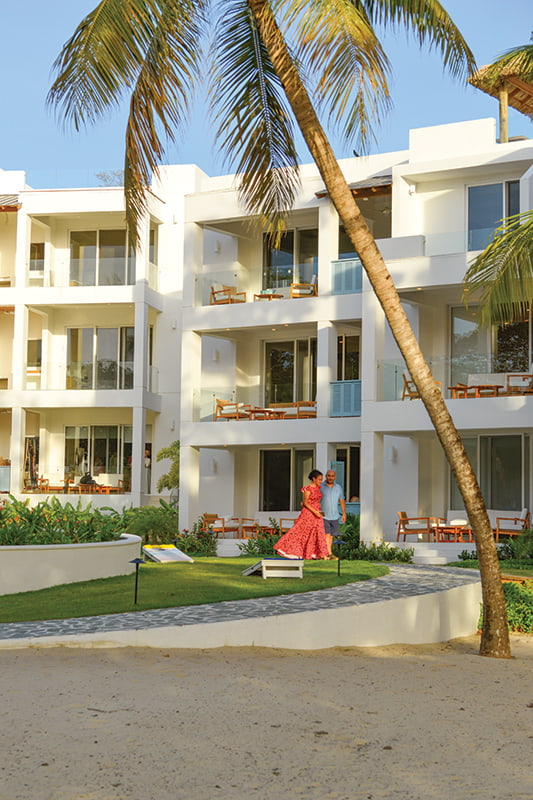
Watercolors condominiums in West Bay.
Northview
NorthView is an example of one of the new projects that have launched on the island in the last couple of years. The plan is to create a community of 250-300 homes on 100 acres centered around a beach and a nine-hole, par-3 golf course. The project is being built by Grupo Innovar, a Siguatepeque-based development and engineering company. Innovar is one of several mainland developers that have come to Roatan since 2022.
In 2026 there is plenty of room for developing housing communities on the island. Roatan offers an environment that more developed Caribbean destinations don’t have. They either never had it or lost it. Some became overdeveloped like Cancún, others lack authenticity like the Cayman Islands, some are politically untouchable like Cuba or Nicaragua, or unsafe like Jamaica. “Typically, our buyer demographic is people who are moving away from areas like Cancún and Miami and are looking for a more old Caribbean island experience,” says Steve Hasz.
There are some obvious opportunities and large niches in housing development. One local developer is looking to create a “Blue Zone” development — a housing project that integrates ideas of longevity, active movement, community connection and purpose. “This development could be a type of eco-development with solar power, native landscaping, passive cooling, and low-maintenance materials,” says Hasz.
Roatan is ready for more and better-planned communities that fit the island’s geography and demographics. There is room for several niche housing communities — people of similar interests, similar value systems, and older adults who want an alternative to what they can find in the U.S., Canada or Europe.
Developers on Roatan come from many different backgrounds.
Another niche still unexplored on the island is an assisted living housing development. As the level of health care and health services for the elderly has improved, the island has become a place where people in their late 70s and 80s can consider living.